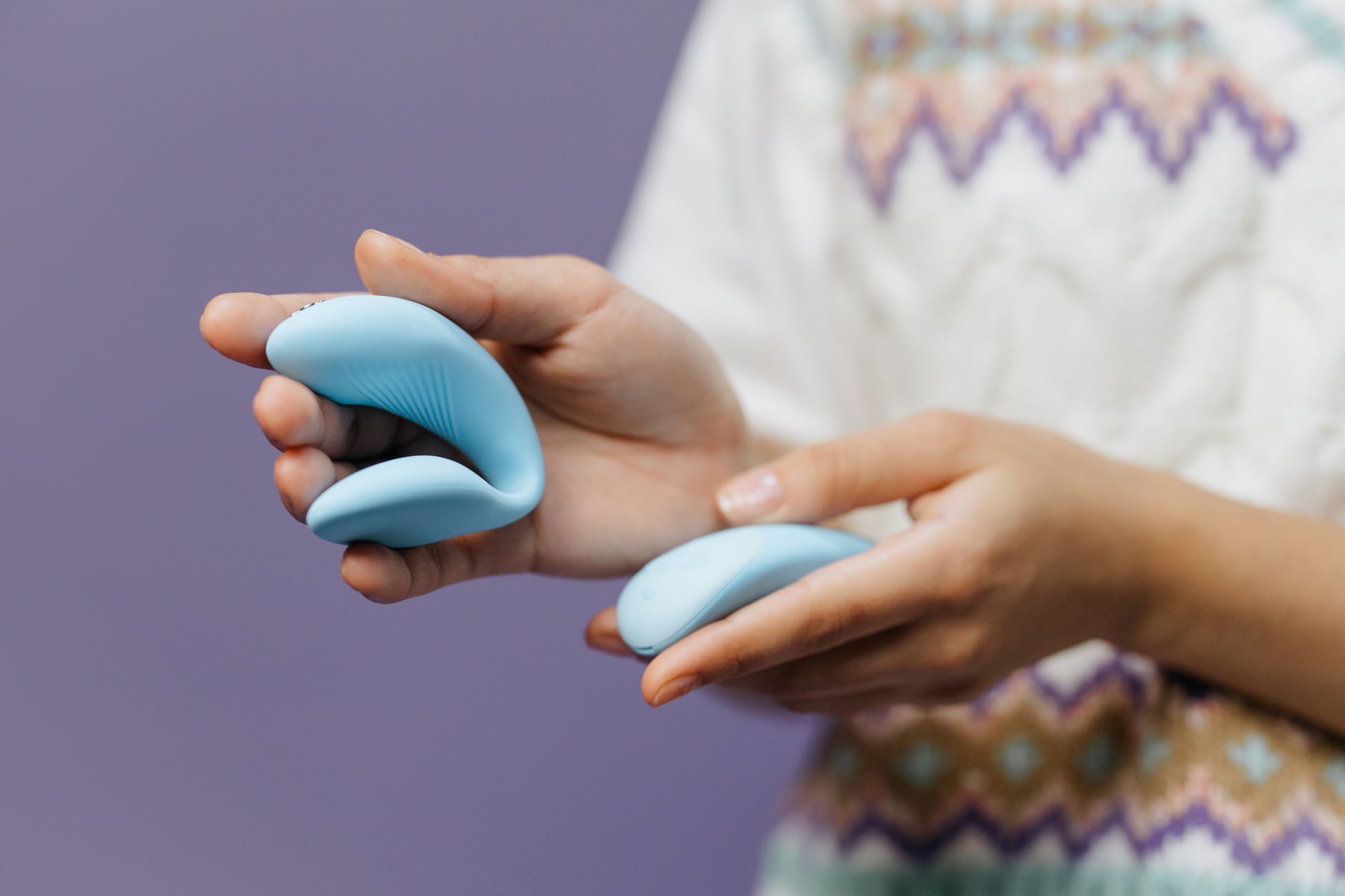
Let's talk about sensation overload
Here's what no one tells you: pleasure can hurt. Not in a pain-play way. I mean the sensation itself feels too sharp, too intense, too much even when you're genuinely turned on and want to continue. It's not broken. It's not abnormal. But it's wildly annoying when you're trying to enjoy yourself and your body feels like it's rejecting the very thing you're asking it to do.
Some people describe it as feeling shocked or zapped. Others say the vibration becomes white noise that pains instead of pleases. For some, it's intensity creep. A few minutes in, sensation that felt good borders on unbearable. The reflex kicks in: you pull away, you tense up, the whole thing shuts down.
There's a physiological reason this happens, and there's a design solution that actually addresses it instead of working around it.
Why standard vibrators can feel too intense
Most traditional vibrators rely on rapid, direct oscillation. The motor buzzes fast and hard in one spot. For plenty of people, that's perfect. For others, especially those with high nerve sensitivity, hypersensitivity conditions, or certain types of arousal patterns, that direct percussion becomes overwhelming within minutes.
Your nervous system has something called vibration threshold, which is partly genetic and partly contextual. When arousal climbs and blood flow concentrates in your vulva, sensitivity can spike rapidly. A setting that felt gentle five minutes ago now feels harsh. Add in cortisol from performance anxiety or overstimulation, and your nervous system tightens further. Sensation spirals from pleasant to painful without warning.
The clitoral tissue itself is also densely packed with nerve endings. There are roughly 8,000 nerve fibers in the clitoris. When you're asking that much sensation density to tolerate sustained high-frequency vibration, sometimes the answer is simply no.
How lemon clitoral vibrators are different
Lemon vibrators and similar design-forward toys use suction or gentler pulsing patterns instead of aggressive buzzing. A lemon clitoral vibrator creates a pulling sensation rather than the percussive impact of a traditional vibrator. This changes everything for people with sensitivity issues.
Why? Suction and gentle pulsing distribute sensation across a wider area and work with your arousal response rather than against it. Instead of one intense point of contact, you get a broader, gentler embrace. The sensation still builds intensity, but the pathway there feels smoother and more controllable.
The pattern matters too. A lemon sucker typically cycles through pulsing rather than constant vibration. Your nervous system can integrate each pulse, instead of drowning in continuous stimulation. You're getting rhythm without relentlessness.
The control factor that changes everything
Most lemon sexual toys have granular intensity settings. Not just low, medium, high. Usually 10 or more subtle increments. This matters enormously when your threshold is narrow.
With a traditional vibrator on its lowest setting, you might jump from just-right to too-much with no middle ground. A lemon clitoral vibrator lets you camp out in that sweet spot for longer. You can warm up at setting 3, stay there for five minutes, move to 4 or 5 when your body feels ready. You're not stuck choosing between "not enough" and "too much." You have granularity.
You also have control mid-way through. If intensity suddenly feels sharp, you don't have to stop entirely. You drop one or two settings and continue. That sense of agency alone calms your nervous system. When your brain knows it can dial intensity down instantly, arousal doesn't vanish in anticipation of pain.
Technique adjustments that amplify control
Using a lemon vibrator correctly when sensation intensity is your issue isn't just about pressing the button. A few shifts make the difference.
Start at the lowest setting and resist the urge to climb quickly. I know this sounds basic. It matters. Many people with sensitivity assume they need to get to higher intensities to "get results." With these toys, lower settings often deliver more pleasure than higher ones. Spend 10 minutes at setting 2 or 3. Notice what happens. Most of my clients find their orgasms are actually stronger when they stay lower longer, because their nervous system hasn't overloaded.
Use the toy on the outer clitoral area first, not directly on the clitoral head. The clitoral glans is the most sensitive spot. For sensitive folks, start on the labia majora or the upper clitoral area. Let sensation build gradually. As arousal intensifies, you can shift toward more direct contact. You're not avoiding intensity, you're managing its timeline.
Wear underwear between your body and the toy. This sounds counterintuitive. But a layer of fabric mutes sensation slightly while preserving the rhythm and pattern. It's like the difference between touching your skin and touching through a shirt. Less direct, same pleasure, significantly less intensity. Many sensitive users say this single shift lets them use lemon clitoral vibrators comfortably when bare skin feels overwhelming.
Pause between sessions. If you're someone whose sensitivity spikes with overstimulation, don't expect to use the toy for 30 minutes and feel fine. Use it for 10 to 15 minutes, take a 5-minute break, continue if you want. Your nervous system recovers. Sensation feels fresh again.
When sensitivity is rooted in tension, not nerves
Sometimes "too intense" isn't actually about nerve sensitivity. It's about pelvic floor tension. A tight pelvic floor muscle grips down harder as arousal increases, which makes any vibration feel sharper and more painful. The sensation problem is actually a tension problem.
If this is you, the control offered by a lemon vibrator helps, but you also need the other half of the solution: learning to relax your pelvic floor during arousal. This takes practice. A sex therapist or pelvic floor physical therapist can guide you. What I see clinically is that once people learn to release pelvic floor tension and use a lower-intensity toy, pleasure returns. The intensity itself wasn't the problem. The tension plus intensity together created pain.
The mental game: permission to go slow
Here's the hidden part of sensitivity issues that no one talks about. You start bracing for pain because you've had the experience of pleasure turning sharp. Your nervous system anticipates it. You tighten preemptively. The tightening makes sensation worse. A vicious loop.
Using a lemon clitoral vibrator gives you permission to slow down because the toy is explicitly designed for control. You're not trying to force a blunt instrument to work gently. The lemon sucker is the gentle option. This psychological shift matters. You can relax into pleasure instead of defending against intensity.
If you're with a partner, this is also the moment to name what's happening. "When I use a toy with more control, my body relaxes more" is useful information. It's not about the toy being better. It's about your body needing a specific design to let pleasure happen. That's valuable data about your own pleasure, not a limitation.
FAQ: sensation intensity and lemon vibrators
Can you damage your clitoris if vibration feels too intense?
No. Vibration alone doesn't damage nerves. However, pain signals do matter. If sensation causes actual pain, that's your nervous system telling you to stop. Continuing through pain creates neural sensitization. Your body becomes more defensive over time, which worsens sensitivity. The solution is switching tools or techniques, not pushing through.
Is high sensitivity during arousal the same as being "too sensitive" for sex?
Completely different. High sensitivity to vibration doesn't mean you can't enjoy sex or other stimulation. It means this particular type of sensation doesn't work for your nervous system. Many highly sensitive people have incredible orgasms with different tools. A lemon vibrator or a partner's hand might work perfectly when a standard vibrator creates pain.
Should I be using a lower intensity toy if standard vibrators feel intense?
Not necessarily lower intensity, but different intensity. A suction toy like a lemon clitoral vibrator at setting 8 might feel easier than a traditional vibrator at setting 3. It's the pattern and distribution of sensation that matters, not just the wattage. Experiment with design, not just power.
Does sensitivity get worse if you use lemon vibrators regularly?
No. In fact, many people find that using a tool that doesn't create pain actually improves sensitivity over time. Your nervous system calms down. You experience pleasure without bracing. Sensation becomes more nuanced instead of all-or-nothing sharp. Regular use of the right toy often expands your capacity for pleasure.
What if sensation feels intense even with a lemon clitoral vibrator on the lowest setting?
Start with the underwear-between-you-and-toy technique. Use it for just five minutes at a time. Or explore non-vibration stimulation: a partner's touch, a vibrator held still against you without pulsing, or manual stimulation. Sometimes your body needs weeks to recalibrate to any new sensation. Patience changes what's possible.
Can I use a lemon sucker if I'm taking antidepressants that numb sensation?
Yes. The gentler pattern of a lemon vibrator often works better for people experiencing medication-related numbness because it requires less intensity to register. You might still need longer warm-up time and lower settings, but the design is typically more compatible with dulled sensation than traditional vibrators are. If sensation remains completely absent after weeks of experimentation, talk to your prescriber about timing or dosage adjustments.
What happens when you stop bracing
I've worked with hundreds of people for whom intensity felt painful. The shift usually happens around week three of using the right tool. Your nervous system stops anticipating pain. Arousal builds without flinching. Pleasure deepens because you're not half-defending against it.
Sensitivity isn't a flaw. It's information about your nervous system. A lemon clitoral vibrator isn't a workaround. It's a tool built for that information. Use it that way, and sensation stops being overwhelming. It becomes what it was supposed to be.
If you want to explore this further, reach out to our team. We can help you figure out what design might work best for your body, or connect you with a sex therapist who specializes in sensation sensitivity and pelvic floor work.