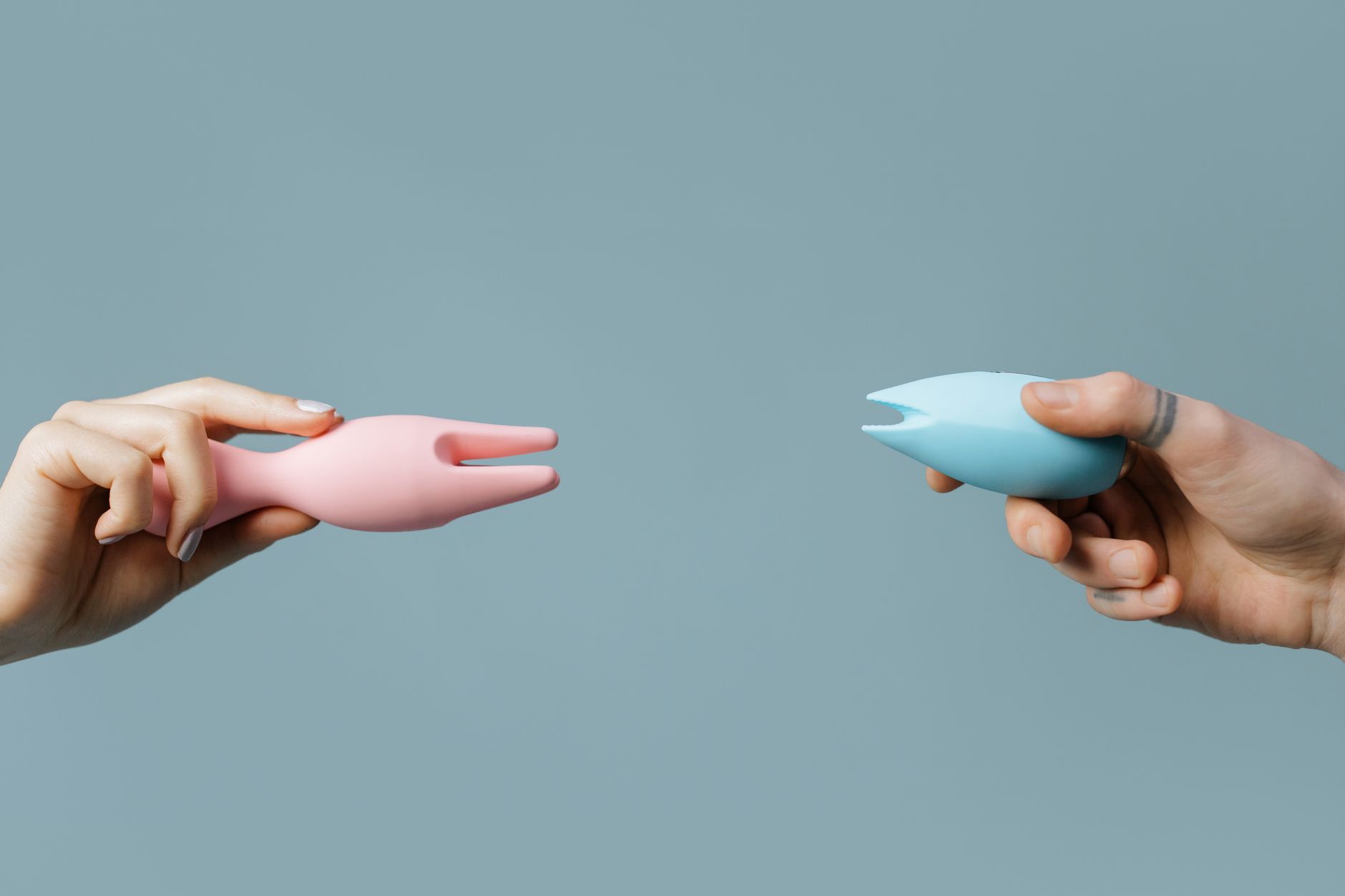
Here's what actually changes when hormones fluctuate
Your orgasm didn't break. But it probably feels different, and that's the part nobody explains clearly. Hormonal shifts (whether from birth control, pregnancy, postpartum recovery, menopause, or stress cycles) rewire how your nervous system experiences climax. The sensation can feel shallower, slower to build, scattered, more localized, or weirdly intensified all at once. Some people lose the full-body wave entirely and get a tighter, more concentrated release instead.
That's not a problem. It's information.
I've worked with hundreds of people navigating this shift, and the ones who adapt fastest aren't the ones who keep chasing the old orgasm. They're the ones who learn what this new version actually needs. And that's where lemon clitoral vibrators come in.
Why your orgasm feels different (the physiology)
Estrogen affects three things that directly shape climax:
Clitoral tissue thickness and blood flow. When estrogen is high or stable, the clitoris engorges more, which means faster arousal and more obvious physical sensations. When estrogen dips or fluctuates wildly, that engorgement happens more slowly or less completely. Your clitoris still has the same nerve endings, but the scaffolding around them changes. It's like the difference between a thick, ripe peach and a slightly dehydrated one. Same fruit. Different texture.
Vaginal lubrication and pelvic floor tension. Hormones regulate how quickly your body produces natural lubrication and how readily your pelvic floor muscles relax. When hormones are unstable, that chain reaction gets interrupted. Your body might not produce enough lubricant to make friction feel good, or your pelvic floor might tense up before you're ready for it to. This alone can make orgasm feel blocked or incomplete.
Neurotransmitter sensitivity. Estrogen shapes how your brain's pleasure centers respond to dopamine and serotonin. Lower or fluctuating estrogen can make it harder to hit that threshold where orgasm actually releases. It's like turning up the volume on your stereo but the speakers aren't as responsive. The signal is still there.
Here's the part they don't tell you: progesterone, testosterone, and even cortisol (your stress hormone) layer onto this. A high stress week during a low-estrogen phase is not the same as a high stress week during a high-estrogen phase. Same stressor. Different nervous system state. Different orgasm.
Why lemon vibrators work differently during hormonal shifts
Lemon suction vibrators like Hello Nancy Avo Shop's lemon clitoral vibrator use air-pulse technology instead of traditional vibration. That matters enormously when your hormones are in flux.
Traditional vibration requires direct, sustained friction. When hormonal changes make your tissue thinner, more sensitive, or slower to engage, friction-based stimulation either feels too intense or doesn't build arousal efficiently. You end up chasing sensation instead of riding it.
Suction works by creating rhythmic pulses that stimulate the clitoris and surrounding tissue without requiring the same mechanical pressure. The lem vibrator essentially massages the entire clitoral complex (not just the visible tip) using waves of suction. During hormonal fluctuations, this approach is gentler on sensitive tissue, more likely to produce consistent arousal, and weirdly better at creating that full-body sensation people worry they've lost.
Many clients report that when they switch to a lemon suction toy during a hormonal dip, orgasm comes back faster and feels more complete. Not because the toy is magic, but because the mechanism matches what their body actually needs during that phase.
How your orgasm pattern might shift
Understand what you're actually looking for so you don't mistake change for loss.
If your orgasm used to be a big full-body wave and now it's tighter and more localized, that's not less pleasure. It's a different architecture. You might need more time on patterns 1 or 2 of the lem vibrator's settings instead of jumping straight to the higher intensities. You might discover that longer sessions of lower intensity feel better than the quick sharp peaks you used to prefer. Neither is better. They're just different.
If arousal takes longer, budget for it. This isn't failure. Longer arousal phases often create deeper, more complex orgasms once they finally arrive. The whole arc changes, not the destination.
If you're having multiple orgasms, you might notice they feel different from each other now. First one is scattered and slow. Second is sharp and localized. Third doesn't happen. That's hormones regulating your refractory period (the recovery time between orgasms). This is actually healthy. Your nervous system is doing its job, just on a different timeline than before.
The integration problem (and how to solve it)
Here's where people get stuck: they assume that because their orgasm feels physically different, something is wrong with their desire or their relationship.
It's not.
Physical sensation and desire live in different parts of your brain. When hormones shift, the physical sensation changes but the desire circuits stay intact. The problem is that our culture treats orgasm like a simple on-off switch. It's not. It's a complex system with multiple dials. Hormones adjust the dials. Your job is to notice which dials have moved and then recalibrate.
If you have a partner, the integration happens through information sharing, not reassurance. "My orgasm feels different right now, and here's what I've learned helps" is infinitely more useful than "I'm just not feeling it anymore." One is a problem to solve together. The other sounds like a relationship problem when it's actually a physiology problem.
This is where a lemon suction vibrator becomes a tool for discovery instead of a workaround. Using it solo first lets you map your new pleasure terrain without performance pressure. You get to learn what patterns, durations, and intensities work for your current hormonal state. That information is gold when you bring it back to partnered sex.
Timing matters more than you think
If you menstruate, your orgasm isn't static across your cycle. Day 5 of your cycle feels different from day 20. Different lubrication, different clitoral engorgement, different pelvic floor tone, different threshold.
During the follicular phase (roughly days 1-14), as estrogen rises, arousal usually gets easier and orgasms feel bigger. During the luteal phase (roughly days 15-28), as estrogen drops and progesterone rises, arousal takes longer and orgasms feel more localized.
This isn't a bug. It's the normal rhythm of your body. But most of us were never taught to notice it, let alone work with it.
When you're using a lemon clitoral vibrator, pay attention to what works best on different cycle days. You might find that you prefer patterns 2-3 during your follicular phase and patterns 1-2 during your luteal phase. Or you might prefer longer sessions in one phase and faster intensity changes in the other. This isn't about being broken. It's about being literate in your own body's language.
If you take hormonal birth control, use hormonal IUDs, or take antidepressants, your cycle flattens but the hormonal shifts don't completely disappear. You still get cortisol fluctuations, thyroid variations, and other hormonal layers. The texture of your orgasm still changes week to week. Same principle. Slightly different timeline.
When to seek actual help
Orgasm feeling different is normal. Pain during orgasm is not. Orgasm disappearing entirely for weeks is not. Numbness that doesn't shift even when you adjust your approach is not.
If any of those things are happening, see a healthcare provider who understands hormones (a menopause specialist, a therapist trained in sex therapy, a gynecologist who isn't dismissive). There are actual treatments. Topical estrogen creams, testosterone therapy, pelvic floor physical therapy, and medication adjustments exist and work.
Your pleasure matters. Not as a luxury. As a marker of your overall health and relationship satisfaction. If it's genuinely broken instead of just different, fix it.
Questions people actually ask
Can hormonal birth control permanently change how my orgasm feels?
No, but it can feel that way. Most hormonal methods suppress your natural cycle and create a flatter, more consistent hormone level. Your orgasm adapts to that new baseline. When you stop the medication, your orgasm usually comes back to something like its original shape, though it takes a few cycles to fully reset. If you've been on the same hormonal method for years and you're noticing orgasm has become shallower, it might be worth trying a different formulation with your doctor. Sometimes the issue isn't hormones broadly but the specific hormone dose you're getting.
Why does my orgasm feel better in the first half of my cycle and worse in the second half?
Estrogen peaks just before ovulation (around day 13-14 of a 28-day cycle). During this window, your clitoris is more engorged, your natural lubrication is highest, and your nervous system is primed for arousal. This is why the follicular phase typically feels like sex comes more easily. During the luteal phase, progesterone rises and estrogen drops. This creates a different neurochemical environment. Your arousal threshold goes up. Your pelvic floor is often more tense. Some people find this phase gives deeper, more intense orgasms once they get there. Others find it feels blocked. Both are completely normal variations.
Does using a lemon vibrator change my natural orgasm response over time?
No more than your own hand does. Pleasure habituation is real. If you use the same toy in the same way every single time, your brain adapts and you might need to vary the approach. But lemon suction vibrators have multiple intensity patterns and durations, so there's lots of room for variation. Rotate between patterns. Use it different times of day. Try different positions. The tool itself doesn't diminish your ability to orgasm from other stimulation. It just works differently than your hand or a partner's hand, which keeps your nervous system engaged instead of habituated.
What if hormonal shifts make me feel numb during sex?
Numbness often shows up when your pelvic floor is over-tense or when you're in your head instead of in your body. Hormonal shifts can trigger both. A lemon clitoral vibrator can help break that pattern because the sensation from suction feels different enough that it sometimes pulls your attention back into your body. But if numbness persists, pelvic floor physical therapy is worth exploring. A specialist can teach you to identify and release chronic tension that hormones might be making worse. That's not a toy problem. That's a nervous system problem that sometimes benefits from professional help.
I'm postpartum and my orgasm feels totally different. Is this permanent?
Postpartum bodies have dropped estrogen, depleted nutrient stores, disrupted sleep, and pelvic floor muscles that took trauma during labor. Of course your orgasm feels different. It's not permanent, but it's not a quick fix either. Most people see significant shifts between 3-12 months postpartum as their hormones restabilize and they recover physically. In the meantime, a lemon clitoral vibrator can help you reconnect with sensation on your new body's terms without the performance pressure of partnered sex. Many people find that using one solo helps them understand what their body needs now, which makes sex with a partner easier to navigate.
Does stress really affect how my orgasm feels?
Yes, massively. Cortisol (your stress hormone) directly competes with sex hormones and makes your pelvic floor chronically tense. A high-stress week during a low-estrogen phase will feel worse than a high-stress week during a high-estrogen phase. Your nervous system is less able to shift into pleasure mode when cortisol is high. This is why so many people notice their orgasm comes back when they finally take a vacation. It's not the vacation itself. It's the cortisol drop. If you're managing a stressful period and your orgasm feels flat, try a lemon vibrator in a completely relaxed environment. No performance pressure. No time limit. No phones. Just sensation. That combination of lower stress and direct pleasure stimulus often helps your body remember what it's capable of.
The real shift
Hormonal fluctuations don't end pleasure. They reshape it. The people who thrive through these transitions aren't the ones who keep chasing the old sensation. They're the ones who get curious about the new one.
A lemon clitoral vibrator isn't a fix for hormonal change. It's a tool for exploring what your body actually wants right now instead of grieving what it used to want. That's the whole game.
Ready to reconnect with what feels good? Reach out to our team or explore what works best for your current phase of life.